Microsoft Azure architecture transforms complex global infrastructure into manageable components organized hierarchically for scalability, security, and cost control. Understanding regions, resource groups, networking, compute, and management layers unlocks Azure's power for enterprise deployments. This beginner-friendly guide breaks down every architectural component with practical business applications.
Global Physical Infrastructure Foundation
Azure Regions form the top-level geography, 60+ distinct areas worldwide containing multiple datacenters. Each region, like East US or Southeast Asia, operates independently for sovereignty, latency optimization, and disaster recovery. Businesses deploy workloads close to users; regulated industries choose sovereign regions for data residency.
Availability Zones provide intra-region fault tolerance, physically separate datacenters within each region connected by high-speed fiber. Zone-redundant services automatically replicate across all zones; zonal services pin to specific zones for low latency. Minimum three zones per region ensures 99.99% SLA through fault isolation.
Region Pairs enable cross-region disaster recovery and automatic failover during regional outages. East US pairs with West US 2; the automatic traffic manager rerouting maintains availability during rare dual-region failures.
Resource Organization Hierarchy
Management Groups organize enterprise-scale governance containers holding subscriptions that inherit policies automatically. Apply region restrictions, spending limits, or security baselines once at the management group level, affecting thousands of resources instantly.
Subscriptions represent billing and access boundaries, group user accounts with resource creation quotas. Enterprises use separate subscriptions for dev/test, production, and department budgets with distinct RBAC boundaries.
Resource Groups act as logical containers grouping related resources (VMs, storage, networking) for unified lifecycle management. Delete entire application stacks instantly; apply tags for cost allocation; manage access at the group level rather than individual resources.
Azure Resource Manager (ARM): The Control Plane
ARM serves as Azure's unified management layer, REST API orchestrating all resource creation, updates, and deletions across subscriptions. ARM templates enable Infrastructure-as-Code (IaC) deployments; Bicep provides simplified syntax over JSON. Role-Based Access Control (RBAC) scopes permissions granularly through ARM.
All Azure services integrate through ARMdeploy VM + storage + networking with a single template. Drift detection compares running vs. intended configurations automatically.
Networking Architecture Components
Virtual Networks (VNet) create logically isolated network environments spanning regions with public/private subnets. Peering connects VNets across subscriptions/regions without gateways; service endpoints secure PaaS access.
Network Security Groups (NSGs) filter traffic at the subnet/VM level, stateful firewall rules blocking RDP port 3389 except allowed IPs. Application Security Groups simplify management by tagging VMs by function (web, db, app).
Azure Load Balancer distributes Layer 4 TCP/UDP traffic across VMs. Standard tier includes HA ports and zone redundancy. Application Gateway adds Layer 7 HTTP routing, WAF protection, and URL-based rules.
Azure Firewall provides managed network security, threat intelligence, NAT and central logging. Routes all internet-bound traffic through inspection, preventing data exfiltration.
Compute Architecture Options
Virtual Machines deliver IaaS flexibility900+ SKUs from B1s burstable ($4/month) to HBv4 GPU clusters ($10,000+/month). Availability Sets distribute across fault/update domains; proximity placement groups minimize latency.
Azure App Service abstracts PaaS web hosting, deploying .NET, Node.js, and Python apps with built-in scaling, SSL, CI/CD. Multi-tenant isolation protects noisy neighbors automatically.
Azure Functions execute serverless event-driven code, HTTP triggers, blob uploads and queue messages. Consumption plan scales to zero; Premium plan pre-warms instances, reducing cold starts.
Azure Kubernetes Service (AKS) manages container orchestration, auto-scaling pods, service mesh integration and Windows node pools. Managed control plane eliminates complexity.
Storage Architecture Components
Storage Accounts unify blob, file, queue and table services under a single namespace with geo-redundancy options. Locally-redundant storage (LRS) replicates 3x within a datacenter; geo-zone-redundant (GZRS) adds cross-zone, cross-region copies.
Azure Disks provide block storage for VMs: Premium SSD (20K IOPS), Ultra Disk (160K IOPS), Standard HDD. Ephemeral OS disks accelerate boot times; shared disks enable SQL FCI clusters.
Azure Files delivers SMB/NFS shares accessible from multiple VMs. The Premium tier hits 10K IOPS for shared workloads. Active Directory integration enables on-premises file server replacement.
Identity and Access Architecture
Microsoft Entra ID (formerly Azure AD) provides enterprise identity across cloud/hybrid SSO for 20,000+ SaaS apps, Conditional Access blocking risky logins. Managed Identities eliminate service principal secrets for PaaS services.
Azure RBAC scopes permissions granularly: "Reader" views resources, "Contributor" manages, "Owner" controls access. Custom roles combine permissions precisely for compliance.
Monitoring and Management Layer
Azure Monitor collects metrics/logs/traces across resources. Alert rules trigger on CPU >80% five minutes. Log Analytics queries petabytes via KQL; Application Insights APM traces distributed transactions.
Azure Policy enforces compliance as code, and "deny public blob access" prevents misconfigurations automatically. Blueprints combine policy + ARM templates for environment standardization.
Azure Cost Management analyzes spending patterns, budgets, alert overspend, and Advisor recommends rightsizing, saving 30-65%. Reservations cut compute costs 72% for predictable workloads.
Data Services Architecture
Azure SQL Database delivers a managed relational database serverless auto-scaling, Hyperscale 100TB storage and zone-redundant HA. Azure SQL Managed Instance bridges on-premises migration, preserving T-SQL features.
Azure Cosmos DB provides globally-distributed NoSQL multi-region writes, five consistency models and automatic indexing. Serverless capacity scales instantly during traffic spikes.
Security Architecture Components
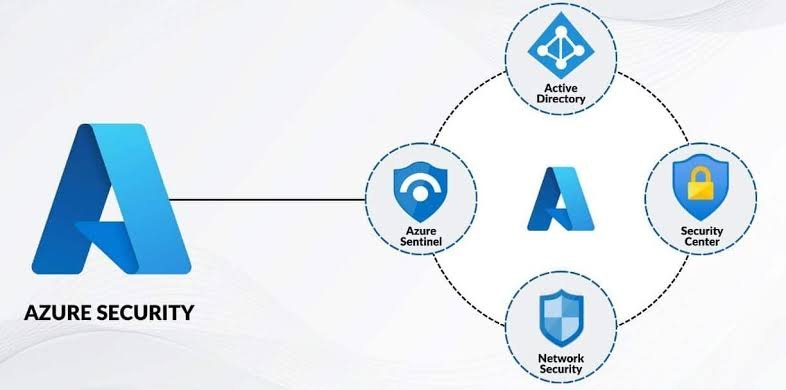
Microsoft Defender for Cloud provides CSPM across multi-cloud, vulnerability assessment, threat detection and regulatory compliance dashboards. Just-in-time VM access limits RDP exposure to one hour.
Azure Key Vault centrally manages certificates, encryption keys, secrets, HSM-backed keys, RBAC access and automatic rotation. Private endpoints prevent public internet exposure.
Azure DDoS Protection mitigates volumetric attacks, network-layer scrubbing, and adaptive tuning based on traffic patterns. Standard tier includes cost protection during attacks.
Typical Enterprise Architecture Pattern
Production workloads deploy across a minimum of two regions with zone redundancy enabled. Traffic Manager routes to the lowest-latency healthy endpoint; Azure Front Door accelerates global CDN delivery. Private endpoints secure PaaS services; Azure Firewall inspects egress traffic.
Resource Groups are organized by application lifecycle: prod-web-rg, prod-db-rg enable isolated management. Management Groups apply governance to prevent region mismatches or public storage creation. ARM templates version control entire environments.
Understanding Azure architecture components transforms cloud complexity into predictable scalability. Regions provide geography, zones ensure availability, resource groups organize logically, ARM manages declaratively, networking isolates securely, and monitoring observes continuously, together powering mission-critical enterprise solutions worldwide.