In today's digital landscape, organizations increasingly adopt multi-cloud strategies to avoid vendor lock-in, optimize costs, and leverage specialized services from providers like AWS, Azure, and Google Cloud. This approach offers flexibility but introduces complex multi-cloud security challenges that can undermine even the most robust IT setups. Understanding these issues and implementing targeted best practices is essential for protecting data and maintaining compliance in a fragmented environment.
Key Multi-Cloud Security Challenges
Multi-cloud environments amplify risks due to differing security models across providers, leading to configuration drift and oversight gaps. One primary challenge is limited visibility, where security teams struggle to monitor assets, logs, and traffic spanning multiple platforms, creating blind spots for threats. For instance, a misconfiguration in one cloud might connect to an over-permissioned resource in another, enabling attackers to move laterally undetected.
Identity and access management (IAM) inconsistencies rank high among multi-cloud security challenges, as each provider uses proprietary systems that resist seamless integration. This fragmentation often results in excessive privileges, stale accounts, or gaps in multi-factor authentication (MFA), heightening unauthorized access risks. Compliance becomes equally daunting, with varying regulations and audit requirements across clouds complicating unified governance.
Data protection and network segmentation add further layers of complexity in multi-cloud setups. Diverse encryption defaults and data governance policies can expose sensitive information, while unmonitored east-west traffic between clouds invites breaches. Recent data shows that 40% of 2024 breaches involved multi-cloud or hybrid data stores, underscoring how these challenges compound with scale.
Common Misconfigurations to Avoid
Misconfigured settings remain a top culprit in multi-cloud security challenges, often stemming from human error during rapid deployments. Unrestricted access to storage buckets, containers, or APIs is prevalent, as teams overlook provider-specific defaults like public S3 buckets in AWS or overly permissive Blob storage in Azure. Similarly, orphaned access keys and overlapping IAM roles across environments erode defenses without centralized oversight.
Network-related pitfalls include inadequate segmentation and unmonitored inter-cloud flows, allowing threats to propagate unchecked. Without consistent firewall rules or traffic logging, attackers exploit these gaps for lateral movement. Addressing these requires proactive scanning of infrastructure as code (IaC) templates before deployment to catch issues early.
Best Practices for Mitigation
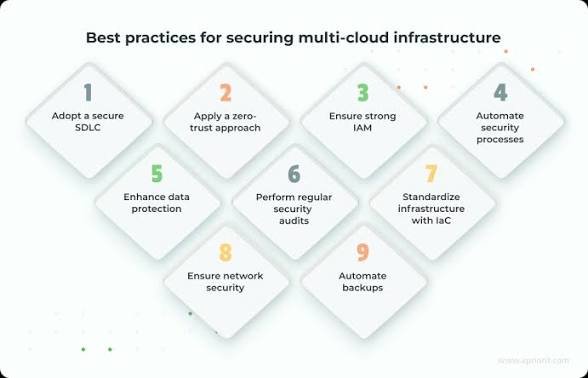
Adopting a centralized security management framework is foundational to overcoming multi-cloud security challenges. Tools like Security Posture Management (SPM) platforms automate policy enforcement, compliance checks, and configuration consistency across clouds, reducing manual errors. Integrating logs into a single SIEM system provides unified visibility, enabling faster threat detection regardless of provider.
Embrace zero trust architecture as a core best practice, verifying every user, device, and workload continuously. Implement micro-segmentation to isolate resources, enforce least privilege access, and mandate MFA universally. Role-based access control (RBAC) with regular audits ensures identities remain tight, while single sign-on (SSO) streamlines authentication without credential sprawl.
Prioritize data encryption in transit and at rest, alongside robust network security like consistent firewall policies. Automate IaC scanning to embed security in DevOps pipelines, preventing misconfigurations from reaching production. For compliance, map controls across providers and automate reporting to ease audits.
Implementing a Unified Strategy
Start with identity centralization using federated IAM solutions that bridge providers seamlessly. Layer on continuous monitoring with agentless tools that scan for drift and anomalies in real-time. Train teams on provider-specific nuances while fostering a culture of shared responsibility for security.
Regular access reviews and privilege minimization directly tackle IAM-related multi-cloud security challenges. Simulate attacks through red team exercises tailored to multi-cloud scenarios to expose weaknesses proactively. As environments evolve, revisit your strategy quarterly to adapt to new threats and features.
Long-Term Resilience Tips
Invest in automation for configuration management, ensuring drift-free environments over time. Partner with vendors offering multi-cloud native tools for integrated protection without rip-and-replace overhauls. Measure success through metrics like mean time to detect (MTTD) and remediate (MTTR), aiming for sub-hour responses.
By systematically addressing multi-cloud security challenges with these best practices, organizations can harness cloud agility securely. This balanced approach not only mitigates risks but also supports scalable growth in hybrid ecosystems.