Enterprise data fuels competitive advantage but becomes a prime cybercrime target when stored in cloud environments. Cloud data security best practices for enterprises create defense-in-depth strategies protecting customer PII, financial records, and intellectual property across multi-cloud deployments. Digital marketers handling campaign analytics or BBA students building data-driven projects need these proven approaches, ensuring compliance with GDPR, HIPAA, and SOC 2 requirements while maintaining business agility.
Understand the Shared Responsibility Model First
Cloud data security best practices for enterprises begin with mastering the shared responsibility model, distinguishing provider protections from customer obligations. Cloud vendors secure physical infrastructure, network firewalls, and hypervisor isolation while enterprises own data classification, encryption implementation, identity management, and application-level security controls. Misunderstanding this division causes 70% of cloud breaches, according to analyst reports.
Implement Zero Trust Identity Framework
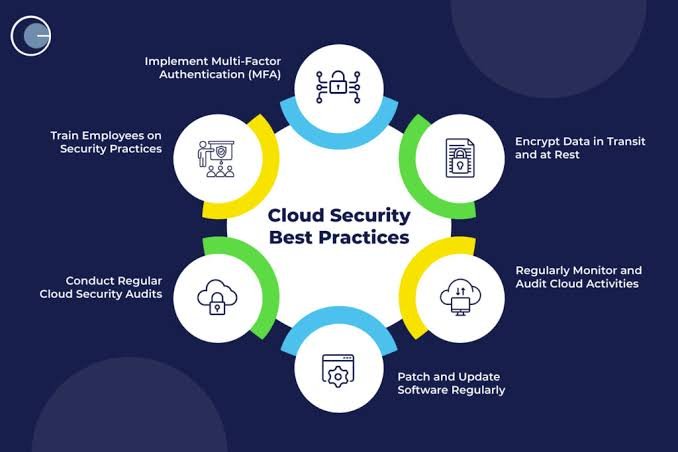
Cloud data security for enterprises demands continuous identity verification, eliminating implicit trust relationships. Deploy multi-factor authentication across all human and machine identities, combined with contextual access decisions evaluating user location, device posture, and behavioral patterns before granting data access. Regularly audit service account permissions, removing dormant credentials representing persistent backdoors into sensitive datasets.
Encrypt Data Throughout Its Lifecycle
Enterprise cloud data protection requires encryption at rest using AES-256 standards across all storage services, including object stores, block storage, and managed databases. Implement TLS 1.3 minimum for data in transit with mutual TLS authentication between microservices, preventing man-in-the-middle interception attacks. Centralize cryptographic key management through cloud-native KMS services with automated rotation policies and hardware security module backing, ensuring unbreakable encryption chains.
Automate Data Classification and Discovery
Cloud security best practices enterprises follow include continuous data discovery scanning S3 buckets, Azure Blob containers, and Cloud Storage for PII, PHI, and financial data patterns. Automatically apply sensitivity labels, triggering encryption, access restrictions, and monitoring policies based on data classification results. Restrict high-sensitivity datasets to approved IP ranges and privileged role clusters, preventing accidental public exposure.
Enforce Granular Access Controls
Least privilege access forms the cornerstone of cloud data security best practices for enterprises requiring role-based and attribute-based policies matching permissions precisely to business requirements. Implement just-in-time elevation for administrative operations, automatically revoking elevated privileges after task completion. Deploy service control policies at the organization level, blocking public bucket creation and cross-account data exfiltration entirely.
Continuous Configuration Monitoring Prevents Drift
Securing cloud data demands perpetual configuration auditing, detecting misconfigured buckets, overly permissive IAM policies, and disabled encryption settings within minutes of creation. Cloud security best practices enterprises adopt integrate CSPM tools, feeding drift detection into centralized SIEM platforms, prioritizing remediation based on business impact rather than static severity scores Automate compliance violation remediation through event-driven serverless functions, correcting dangerous configurations proactively.
Implement Data Loss Prevention Controls
Cloud data security for enterprises includes DLP policies blocking sensitive data upload to unauthorized SaaS applications or email exfiltration attempts. Deploy inline inspection across egress traffic, inspecting content for credit card patterns, health records, and confidential keywords before permitting transmission. Context-aware DLP combines user identity, destination reputation, and data sensitivity, preventing legitimate users from accidental compliance violations.
Centralized Logging Creates Forensic Capabilities
Enterprise cloud data protection requires comprehensive audit trails capturing all data access patterns, configuration changes, and privilege escalations across multi-cloud environments. Forward CloudTrail, Azure Activity Logs, and VPC Flow Logs into tamper-proof data lakes, enabling behavioral anomaly detection through machine learning baselines. Maintain a minimum 90-day retention with immutable storage, preventing evidence deletion during incident response operations.
Regular Key Rotation and Certificate Management
Cloud security best practices that enterprises implement include automated cryptographic key rotation every 90 days across all data encryption contexts, preventing long-term credential compromise. Deploy certificate lifecycle management monitoring, SSL/TLS expiration across load balancers, API gateways, and service mesh, preventing outages from expired trust anchors. Integrate private CA hierarchies, eliminating dependency on public certificate authorities.
Secure Development Practices Protect Data Pipelines
Cloud data security best practices for enterprises extend to CI/CD pipelines, embedding data scanning, secrets detection, and compliance gates, preventing vulnerable code from reaching production environments. Implement Infrastructure as Code validation, blocking Terraform templates from creating unencrypted storage or permissive access patterns during pipeline execution. Container image scanning and SBOM generation track third-party dependencies accessing enterprise datasets continuously.
Incident Response Planning Saves Millions
Enterprise cloud data protection includes predefined response runbooks for ransomware encryption, credential compromise, and data exfiltration scenarios tested quarterly through breach simulation exercises. Cloud security best practices enterprises follow maintain isolated forensic environments and automated evidence collection, preserving the chain-of-custody during law enforcement investigations. Regular tabletop exercises familiarize incident response teams with cloud-specific attack patterns and recovery procedures.
Compliance Automation Generates Audit Evidence
Cloud data security for enterprises leverages policy-as-code frameworks, mapping security controls to NIST 800-53, ISO 27001, and PCI-DSS requirements automatically. Continuous compliance monitoring generates executive dashboards quantifying risk exposure across business units, facilitating board-level reporting. Automated evidence collection eliminates manual audit preparation, costing enterprises millions annually.
Vendor Risk Management Extends Security Perimeter
Securing cloud data requires a third-party risk assessment evaluating SaaS providers handling enterprise datasets through standardized questionnaires and continuous API monitoring. Cloud security best practices that enterprises implement include data processor agreements mandating encryption, annual penetration testing, and immediate breach notification clauses. Right-to-audit provisions enable validation of vendor security claims, protecting enterprise liability exposure.
Employee Training Addresses Human Risk Factor
Cloud data security best practices for enterprises recognize that phishing susceptibility creates initial breach vectors compromising cloud credentials. Regular security awareness training teaches employees to recognize bucket policy manipulation attempts and suspicious access grant requests appearing legitimate. Gamified training platforms track engagement, measuring behavior change through reduced click rates on simulated attacks.
Start with Three Critical Controls Today
Begin enterprise cloud data protection journey, implementing data encryption everywhere, MFA across all accounts, and public access blocking as immediate priorities. Layer additional cloud data security best practices incrementally, building comprehensive protection supporting digital transformation initiatives confidently. Consistent execution transforms security from a cost center into a strategic enabler, driving enterprise competitiveness.