As businesses embrace digital transformation, moving from traditional infrastructure to the cloud has become a strategic necessity. However, without a clear cloud migration strategy, organizations risk downtime, data loss, and increased costs.
This guide provides a structured, step-by-step approach to help businesses successfully migrate their applications, data, and workloads to the cloud.
What Is a Cloud Migration Strategy?
A cloud migration strategy is a detailed plan that defines how an organization moves its digital assets, applications, data, and IT processes from on-premise systems to cloud environments.
It includes selecting the right cloud model, choosing providers, assessing risks, and ensuring minimal disruption during the transition.
Benefits of Cloud Migration
1. Cost Optimization
Reduce capital expenditure on hardware and shift to a pay-as-you-go model.
2. Scalability and Flexibility
Easily scale resources based on business demand.
3. Improved Performance
Leverage high-performance infrastructure provided by cloud vendors.
4. Enhanced Security
Cloud providers offer advanced security features and compliance standards.
5. Business Continuity
Better disaster recovery and backup solutions.
Common Challenges in Cloud Migration
1. Data Security Risks
Ensuring safe data transfer and storage is critical.
2. Downtime and Disruption
Poor planning can lead to service interruptions.
3. Compatibility Issues
Legacy systems may not integrate easily with cloud platforms.
4. Cost Overruns
Unexpected expenses can arise without proper budgeting.
5. Skill Gaps
Lack of expertise in cloud technologies can slow down migration.
Step-by-Step Cloud Migration Strategy
Step 1: Assess Your Current Infrastructure
Evaluate existing applications, workloads, and dependencies to understand what needs to be migrated.
Step 2: Define Migration Goals
Set clear objectives such as cost reduction, improved performance, or scalability.
Step 3: Choose the Right Cloud Model
Decide between:
- Public Cloud
- Private Cloud
- Hybrid Cloud
Step 4: Select a Cloud Provider
Choose a provider based on pricing, services, compliance, and support (e.g., AWS, Microsoft Azure, Google Cloud).
Step 5: Select a Migration Strategy (6 Rs)
- Rehost (Lift and Shift) – Move applications without changes
- Replatform – Make minimal optimizations
- Refactor – Redesign applications for the cloud
- Repurchase – Switch to SaaS solutions
- Retire – Remove unused applications
- Retain – Keep some systems on-premise
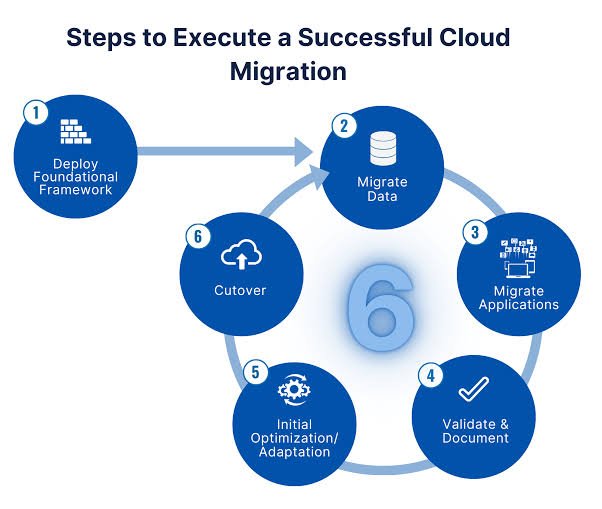
Step 6: Plan Data Migration
Ensure secure and efficient transfer of data with minimal downtime.
Step 7: Test Before Full Deployment
Run pilot tests to identify issues and ensure performance.
Step 8: Execute Migration
Move workloads in phases to reduce risks and ensure stability.
Step 9: Monitor and Optimize
Continuously track performance, security, and costs after migration.
Best Practices for Successful Cloud Migration
1. Start Small
Begin with non-critical workloads to reduce risk.
2. Ensure Strong Security Measures
Use encryption, access control, and compliance checks.
3. Train Your Team
Invest in cloud training and certifications.
4. Use Automation Tools
Automate deployment, monitoring, and scaling.
5. Maintain Backup and Recovery Plans
Always have contingency plans in place.