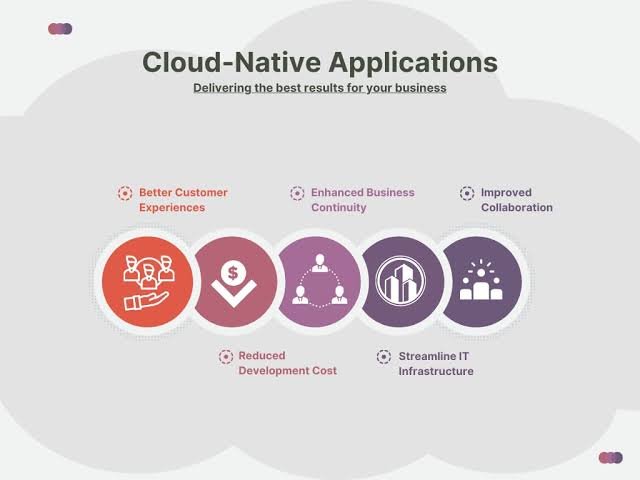
Creating cloud-native applications represents a transformative way to design and deploy software. This approach positions the cloud as the central platform, ensuring applications operate smoothly on public, private, or hybrid cloud environments.
Cloud-native applications offer more than just flexibility. They allow developers to release updates rapidly, maintain higher quality standards, and minimize the risks associated with conventional development methods.
This article explores concrete examples of cloud-native applications, highlighting their benefits and demonstrating why this method is reshaping the future of software development.
Defining Cloud-Native Software: Key Concepts and Principles
Modern cloud computing enables software to be built in a way that maximizes flexibility, speed, and efficiency. Cloud-native applications are designed from the ground up to thrive in this environment.
Instead of relying on a single, all-encompassing structure, these applications are divided into multiple independent components known as microservices. Each component performs a specific function and can operate, update, or scale without affecting the rest of the system.
This modular approach allows teams to assemble software much like a set of interlocking pieces. Developers can introduce new features, replace components, or expand capabilities quickly while maintaining stability and reducing the need for extensive testing.
Improving Scalability and Performance with Cloud-Native Design
Cloud-native applications are created to fully exploit the capabilities inherent to cloud platforms and their associated processes. These applications can scale efficiently, adapt rapidly to change, and integrate with cloud services to expand functionality with minimal coding effort.
Developers today approach cloud-native software with the cloud as the central consideration. Applications are often built using concepts and structures that emerged specifically for cloud environments, allowing them to operate with speed and flexibility.
To gain the full benefits of cloud-native development, it is essential to adopt a new mindset toward software creation. Traditional methods, which rely on exhaustive planning and long development cycles, must be replaced by iterative approaches that deliver features continuously and respond swiftly to evolving requirements.
3 examples of cloud-native applications
Software Containers
Software containers are self-contained packages that include an application together with everything it needs to run reliably across computing environments. These packages hold the application code, its runtime, libraries, and configuration files, making the environment consistent whether the container is executed on a developer workstation, a public cloud server, or a private data center.
Containers differ from traditional virtual machines because they share the host operating system kernel while isolating the application processes. This makes them far lighter, faster to start, and more efficient in resource usage than virtual machines that require dedicated operating systems.
Because containers encapsulate all required components, applications packaged in this way can operate on any infrastructure that supports container runtimes. This means that a container created on one platform will behave in the same way on another, removing the need for platform-specific adjustments.
This portability has made containers foundational to modern cloud application architecture. Developers can build modular services, deploy them rapidly, and scale them across multiple servers without rewriting code for each environment.
In practice, containers are managed and scheduled by orchestration systems such as Kubernetes, which automate the tasks of deploying, scaling, and maintaining large numbers of containerized workloads across clusters of machines. Kubernetes has become the dominant platform in this area because it supports features such as automatic scaling, self-healing of services, and efficient load distribution.
Amazon Web Services (AWS) is a leading host for containerized applications, with nearly eighty percent of cloud container workloads running within its ecosystem. AWS also provides a range of tools for operating containers at scale, such as managed Kubernetes services and container registries.
Software Defined Infrastructure
Software-defined infrastructure refers to an IT environment where the control and management of core computing resources is handled through software rather than manual hardware configuration. In this model, servers, storage, and networking are abstracted into flexible pools that can be managed as software objects, making it possible to adjust capacity and capabilities without physically modifying devices. This abstraction allows infrastructure to behave as programmable resources that can be allocated, scaled, and automated from central management tools.
In traditional data centers, each physical piece of equipment requires direct setup and manual adjustments. With software-defined infrastructure, the responsibility for provisioning, monitoring, and resource allocation shifts to software layers that orchestrate these functions automatically, often through application programming interfaces (APIs) and infrastructure‑as‑code tools.
One of the defining characteristics of this approach is that it decouples infrastructure from underlying hardware vendors, giving teams the freedom to choose components without being locked into specific brands or devices. Virtualization technologies abstract compute, network, and storage elements into a unified framework that supports rapid changes in resource demands without lengthy configuration cycles.
Because software-defined infrastructure treats hardware resources as programmable services, it becomes much simpler to expand capacity, reassign computing power, or switch workloads in response to changing needs. Infrastructure can be scaled up to handle peak demand or scaled down to reduce costs, and many management tasks, such as service start‑up and shutdown, can be automated.
Cloud‑native applications assume the presence of this flexible, software‑driven foundation. They rely on infrastructure that can adapt dynamically to the application requirements rather than requiring static, hardware‑fixed environments. SDI also supports hybrid cloud integration and enables features such as rapid provisioning, centralized monitoring, and consistent resource delivery across on‑premises and cloud platforms.
Application Programming Interfaces (APIs)
Application Programming Interfaces, commonly abbreviated as APIs, are defined sets of rules and protocols that allow different software systems to exchange information and services with one another. They act as gateways that enable one program to request specific functions or data from another program without exposing all of its internal workings. In essence, APIs define how software components should interact to perform particular tasks.
APIs are fundamental to modern application development because they allow software creators to incorporate features from external systems without writing those features themselves. This reduces development time, increases reliability, and allows developers to focus on their core application logic instead of redundant functionality.
For example, mapping services provided by a third‑party platform can be incorporated into a separate application by invoking that service’s API. A real estate application might contact a mapping service API to retrieve and display geographic data, eliminating the need for the developer to build complex mapping functions from scratch.
APIs are not limited to cloud services, but cloud APIs in particular enable seamless connections between cloud platforms and other applications. These interfaces allow programs to leverage cloud‑based storage, analytics, machine learning, and many other scalable services using standardized communication protocols such as HTTP.
Well‑designed APIs provide a secure, consistent mechanism for software integration. They make it possible for developers to extend application capabilities, reuse existing services, and create richer, more feature‑complete systems without rebuilding every piece of functionality on their own.
Three Key Business Advantages of Cloud-Native Applications
Cloud-native development has become highly attractive to organizations because it provides flexibility, efficiency, and broad deployment possibilities. The following characteristics explain why forward-thinking companies prioritize this approach.
1. Flexibility
Applications built using cloud-native principles can evolve in response to changing business requirements without creating rigid dependencies or locking users into a single software version. For instance, a company may decide to provide a mobile interface for its existing application. By utilizing APIs, the mobile front-end can retrieve data from the server without altering backend code. This separation ensures that updates to either the frontend or backend can occur independently without disrupting the overall system.
2. Elastic Scalability
Cloud-native applications leverage software-defined infrastructure, which removes reliance on specific physical hardware. Instead of expanding existing servers with costly upgrades, developers can scale horizontally by adding standard, commodity servers to handle increasing workloads. This approach underpins the massive, globally distributed systems of companies such as Amazon and Facebook, where applications must handle millions of simultaneous users efficiently.
3. Broad Portability
Containers and other cloud-native technologies allow applications to run consistently across a wide range of devices, from smartphones to enterprise mainframes, without modification. As edge computing gains traction, where processing occurs closer to the point of data generation, this portability enables businesses to deploy applications wherever they are required, ensuring high performance and rapid responsiveness.
Legacy Systems Compared to Cloud-Native Architecture
While many legacy applications can operate in cloud environments, they rarely achieve the same level of extensibility, scalability, and portability as cloud-native systems. Legacy software can still gain value by leveraging cloud hosting, APIs, or modular extensions through microservices.
For example, older mainframe interfaces, often called green screens, can be modernized by mapping backend input and output fields to graphical user interfaces through APIs. Some legacy programs can even be fully encapsulated within containers to take advantage of cloud scalability and device independence, all without changing the underlying code.
However, systems that remain tied to traditional, server-centric architectures are more susceptible to inefficiencies, bottlenecks, and operational challenges. In contrast, cloud-native applications are inherently modular and flexible, offering organizations freedom in deployment, development, and maintenance while providing users with adaptable, responsive solutions.
Best Practices for Cloud-Native Development
Working with containers, microservices, and APIs requires significant expertise, and it can be challenging for those new to software development. Low-code platforms can simplify many of the complexities associated with traditional approaches, making it easier to build and deploy cloud-native applications.
Cloud-native development emphasizes the process of creating and delivering software rather than the specific environment in which it runs. Modern agile methodologies adopted by cloud-native teams focus on modular components, reusable code, and frequent, incremental releases. Developers are encouraged to utilize existing services whenever possible instead of constructing everything from scratch.
Adding new functionality is often straightforward, allowing developers to demonstrate new features to end users quickly rather than producing lengthy specifications. This approach accelerates feedback and ensures that the final product aligns closely with user needs.
Cloud-native development discourages a mindset of building everything internally. Innovation is expressed through the selection and integration of external services to create features that provide value and enjoyment to users. The ability to combine existing services creatively becomes a central part of the development process and a source of satisfaction for developers.